Search This Blog

Showing posts with label 8990 Holdings Inc.. Show all posts

Monday, May 4, 2015

The Murky Accounting of Vista Land & Lifescapes Inc. (VLL)

Last week, we explained how the Philippine Real Estate Bubble had already burst for 8990 Holdings, Inc. (HOUSE), an up and coming mass housing developer.  A significant chunk of its Installment Contract Receivables (ICRs) are already past due (12.29% of total ICRs) as of year-end 2014.

This week, we are checking to see if the bust has proven to be systemic or has spread to one of HOUSE's main rivals in the mass housing space, namely Vista Land & Lifescapes Inc. (VLL).  VLL is not as dependent on ICRs to finance sales.  Its ICRs represent 347 days sales in 2014 vs. 661 days sales for HOUSE.  As a result, VLL is less leveraged than HOUSE in terms of ICRs.  ICRs as a percentage of Stockholders Equity amounted to only 40.93% as of 2014, less than half the level of HOUSE (94.79%) for the same period.

Like HOUSE, VLL has experienced a significant uptick in both the absolute and relative values of its Past Due But Not Impaired ICRs, particularly the ICRs that are more than 90 days past due.


Total Past Due but Unimpaired ICRs now stand at 8.83% as of 2014.

But unlike HOUSE, the relative value of its Impaired ICRs is still tiny - only 0.63% as of year-end 2014.


What is troubling is that all of VLL's ICRs are classified as Level 3, meaning that the technique used to value the asset (discounted cash flow analysis) are based on unobservable data.  In VLLs case, the particular unobservable data is the discount rate.

In Note 31 of VLL's financial statements, VLL uses the following heirarchy for determining and disclosing the fair value of its financial assets by valuation technique.  There are three levels:

Level 1: quoted (unadjusted) prices in active markets for identical assets or liabilities;

Level 2: other valuation techniques involving inputs other than quoted prices included in
Level 1 that are observable for the asset or liability, either directly or indirectly; and

Level 3: other valuation techniques involving inputs for the asset or liability that are not
based on observable market data (unobservable inputs)

The discount rate used to value VLL's ICRs ranged from 2.01% to 3.09% in 2014 and 1.33% to 3.00% in 2013.


In contrast, the carrying amounts of HOUSE's ICRs approximate fair values since the current market lending rate is equal to the interest rate of the receivables being valued.  As a result, none of the ICRs of HOUSE are classified as Level 1, Level 2, or Level 3. The ICRs of HOUSE bear an annual interest rate ranging from 8.5% to 18.0% in 2014 and 2013 and are collectible in monthly installments over a period of 1 to 25 years (Note 8: Trade and Other Receivables).

The ICRs of VLL bear an annual interest rate ranging from 16.00% to 19.00% and are collectible in equal monthly installments with various terms of up to a maximum of 15 years (Note 9: Receivables).

In Note 4 (Summary of Significant Accounting Policies) of VLL's 2014 financial statements, its receivables are:

"...recognized initially at fair value, which normally pertains to the billable amount. After initial measurement, loans and receivables are subsequently measured at cost or at amortized cost using the effective interest method, less allowance for impairment losses. Amortized cost is calculated by taking into account any discount or premium on acquisition and fees that are an integral part of the effective interest rate (EIR). The amortization, if any, is included in profit or loss. The losses arising from impairment of receivables are recognized in profit or loss."
The fair value of VLL's ICRs are valued using a discount rate which is not observable and which is significantly lower than the discount rate used on HOUSE ICRs (which is the interest rate of the receivables being valued).  "The difference between transaction price and model value is only recognized in profit or loss when the inputs become observable or when the instrument is derecognized."

Significant increases in the discount rate would undoubtedly result in significantly lower fair values of the installment contract receivables.

Two mass housing developers who operate in roughly the same space and provide in-house financing to a similar customer base have vastly different methods of arriving at the fair value of their installment contract receivables.  Both methods are acceptable under current financial reporting standards.  But one is more transparent and the other is murkier.

Which one would you trust?

Tuesday, April 28, 2015

The Philippine Real Estate Bubble Has Already Burst for HOUSE (8990 Holdings, Inc.)

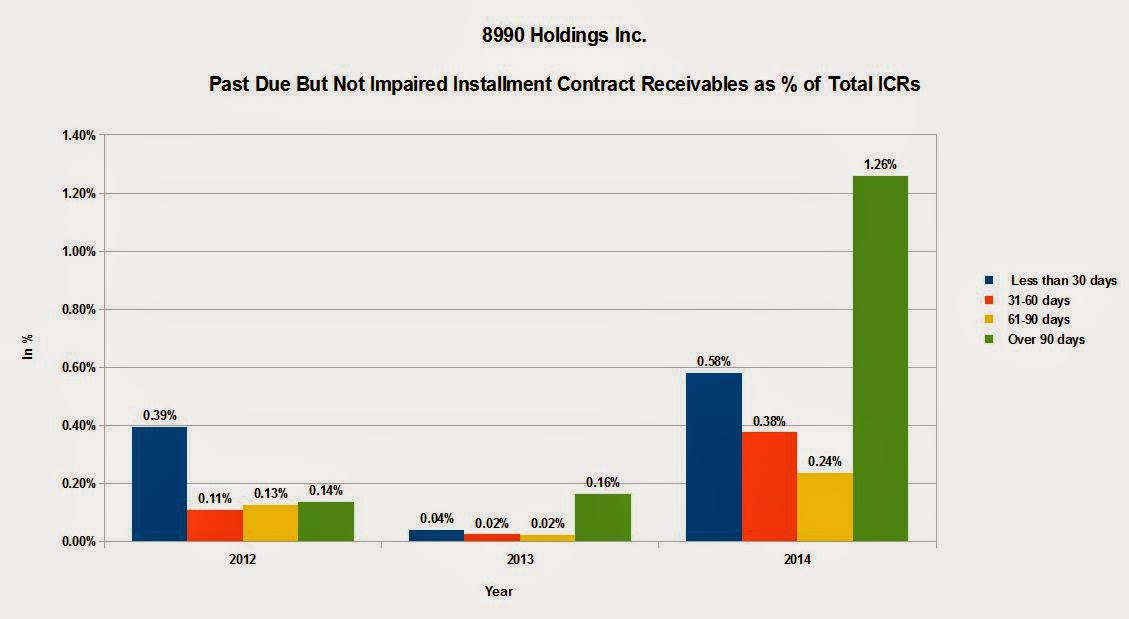
The information has been out for almost two weeks now.  It was disclosed deep in the bowels of the 2014 Annual Report of 8990 Holdings, Inc. (HOUSE).  The real estate bubble has burst ...at least for HOUSE.  There was a marked deterioration in 2014 in 8990 Holdings' Past Due but Not Impaired Installment Contract Receivables both in absolute numbers and relative to its total portfolio of Installment Contract Receivables (ICRs).  An aging analysis buried in the 2014 Annual Report showed that delinquencies jumped by a minimum factor of 10 in all aging categories, whether the unimpaired but past due ICRs were delinquent for: 1) less than 30 days; 2) 31 to 60 days; 3) 61 to 90 days; 4) over 90 days.


A few charts tell the story:


Total Past Due But Not Impaired ICRs now comprise 2.45% of 8990 Holdings Total ICR portfolio as of 2014, an exponential jump from 0.25% in 2013 and 0.77% reported in 2012.

This, by itself, is not worrying.  What is worrying is that 8990 Holdings also reported a gargantuan hockey stick type increase in its Impaired ICRs, both in absolute value and relative to total ICRs.


So now we can see that both Past Due But Not Impaired ICRs as well as Impaired ICRs collectively comprise 12.29% of 8990 Holdings Total ICR portfolio of Php 14.113 billion as of December 31, 2014.

But what does this all mean?

Under 8990 Holdings' business model, the company functions like an in-house bank or mortgage lender, providing a substantial amount of financing to its customers so that these customers in turn can buy their homes.  This model is great... when it works.  For undertaking the risk of financing its customers, the company earns interest income from its customers over and above the gross profits it earns from the sale of a property.  Under this model, the company owns the title to the properties it sells until the property is fully paid off, obviating the need for an expensive and protracted foreclosure process when a customer defaults.

Unlike a bank, 8990 Holdings has a higher cost of funds because not only does it borrow money from banks to finance the development of its properties, it also borrows money from banks to finance its loans to its customers, often by assigning its ICRs to a bank in exchange for ready cash.  A bank has a much cheaper source of funding: its depositors who these days, are paid almost nothing for keeping their money in the bank.  In order to earn a profit on its financing operations, the home financing provided by 8990 Holdings tends to be much more expensive than the home loans provided by banks. Also, the customers of 8990 Holdings tend to me much more marginal and less credit-worthy than bank customers.  After all, why would anyone go to 8990 Holdings if they can get a much cheaper loan from a bank?

Has the company been to aggressive in its focus on sales to the point of sacrificing credit quality? Perhaps.  Have home prices gone up so much past the point of affordability?  Maybe.  Have the company's customers been hit with an economic shock in the past year?  If they have, it is not obvious because the nation's GDP grew at a decent 5.30% clip in 2014. But according to the Philippines Housing Land Use Regulatory Board (HLURB), there was a 16% drop in HLURB's Licenses to Sell in 2014 in the Socialized Housing space, 8990's market niche.

With 12.29% of its customers not paying off their properties on a timely basis means that as a bank, 8990 Holdings would rank as the 19th worst bank in the country in terms of Gross NPLs/Gross Total Loan Portfolio. 

Around 80% of these past due borrowers are in severe default, hence the impaired status.  In other words, these borrowers are in the process of being evicted from their homes and their homes repossessed by the company.

The company has already made provisions of Php 130.857 million for impairment losses and has recognized a loss of Php 56.972 million on property repossessions.  Expect more to come as the "pig" of impaired ICRs" winds through the "python" of the company's eviction and repossession process.


Monday, June 9, 2014

8990 Holdings, Inc.: The Case of the Disappearing Past Due Installment Contract Receivables


In a previous blog post titled "Has the Philippine Real Estate Bubble Already Burst?", we wrote on a little known factoid buried deep within the bowels of the financial statements of 8990 Holdings, Inc. (otherwise known through its stock ticker "HOUSE"), that HOUSE's level of Installment Contract Receivables (ICRs) that are over 90 days past due jumped 500% in the nine months from December 31, 2012 to September 30, 2013.


8990 Holdings Inc.
Installment Contract Receivables, Past Due but Not Impaired
In Php


Audited Unaudited

December 31, 2012 September 30, 2013 % Change
Less than 30 days 76,438,532 102,996,723 34.74%
31 - 60 days 31,128,884 30,426,033 -2.26%
61 -90 days 26,930,290 10,163,708 -62.26%
Over 90 days 39,365,086 236,008,574 499.54%
Total 173,862,792 379,595,038 118.33%


These figures were taken from HOUSE's interim financial statements as of September 30, 2013 which contained audited figures for December 31, 2012 and interim figures for the nine months since then.  The document can be found here and also on the website of the Philippine Stock Exchange.  The Annual Report can be found here and here.

Today, those figures are very much gone or reduced.  The level of past due ICRs were reduced by almost 80% for the very same figures that were audited as of December 31, 2012.


8990 Holdings Inc.
Installment Contract Receivables, Past Due but Not Impaired
In Php


Interim Report Annual Report


Audited Audited


December 31, 2012 December 31, 2012 Variance % Variance
Less than 30 days 76,438,532 18,426,966 -58,011,566 -75.89%
31 - 60 days 31,128,884 5,049,846 -26,079,038 -83.78%
61 -90 days 26,930,290 5,910,360 -21,019,930 -78.05%
Over 90 days 39,365,086 6,357,158 -33,007,928 -83.85%
Total 173,862,792 35,744,330 -138,118,462 -79.44%


Despite an almost 40% jump in sales, the level of past due ICRs were even lower at year end 2013 than they were at year end 2012.


8990 Holdings Inc.
Installment Contract Receivables, Past Due but Not Impaired
In Php


Interim Report Annual Report

Audited Unaudited Audited Audited

December 31, 2012 September 30, 2013 December 31, 2012 December 31, 2013
Less than 30 days 76,438,532 102,996,723 18,426,966 3,824,739
31 - 60 days 31,128,884 30,426,033 5,049,846 2,403,551
61 -90 days 26,930,290 10,163,708 5,910,360 2,177,276
Over 90 days 39,365,086 236,008,574 6,357,158 15,993,266
Total 173,862,792 379,595,038 35,744,330 24,398,832


HOUSE dependence on ICRs to fuel sales has only increased since December 31, 2012.

8990 Holdings Inc.
Installment Contract Receivables/Sales
In Php


Audited Unaudited Audited Audited

December 31, 2012 September 30, 2013 December 31, 2012 December 31, 2013
Installment Contract Receivables 4,672,109,197 8,165,199,990 4,672,109,197 9,777,920,990
Sales 2,888,596,423 4,367,429,533 3,830,644,048 5,356,098,815
Days Sales 437 505 329 493

So has the risk to its stockholders.


8990 Holdings Inc.
Installment Contract Receivables/Stockholders Equity
In Php


Audited Unaudited Audited Audited

December 31, 2012 September 30, 2013 December 31, 2012 December 31, 2013
Installment Contract Receivables 4,672,109,197 8,165,199,990 4,672,109,197 9,777,920,990
Stockholders Equity 3,948,015,021 6,049,131,256 3,948,015,021 6,595,847,184
Installment Contract Receivables/Stockholders Equity 118.34% 134.98% 118.34% 148.24%


8990 Holdings Inc.
Real Estate/Stockholders Equity
In Php


Audited Unaudited Audited Audited

December 31, 2012 September 30, 2013 December 31, 2012 December 31, 2013
Real Estate Inventories 2,040,532,596 2,081,143,259 2,040,532,596 2,243,559,834
Land held for Future Development 1,010,474,241 3,605,811,050 1,010,474,241 3,784,727,576
Investment Properties 142,365,067 140,860,631 142,365,067 141,928,584
Total Real Estate 3,193,371,904 5,827,814,940 3,193,371,904 6,170,215,994


Stockholders Equity 3,948,015,021 6,049,131,256 3,948,015,021 6,595,847,184
Real Estate/Stockholders Equity 80.89% 96.34% 80.89% 93.55%


8990 Holdings Inc.
ICRs & Real Estate/Stockholders Equity
In Php


Audited Unaudited Audited Audited

December 31, 2012 September 30, 2013 December 31, 2012 December 31, 2013
Installment Contract Receivables 4,672,109,197 8,165,199,990 4,672,109,197 9,777,920,990
Real Estate 3,193,371,904 5,827,814,940 3,193,371,904 6,170,215,994
Total 7,865,481,101 13,993,014,930 7,865,481,101 15,948,136,984


10% Losss 786,548,110 1,399,301,493 786,548,110 1,594,813,698
Stockholder's Equity 3,948,015,021 6,049,131,256 3,948,015,021 6,595,847,184
Impact of 10% Loss 19.92% 23.13% 19.92% 24.18%


Impairment Losses

Based on its Annual Report, the company has now made provisions for impairment losses of Php 2,795,106 as of December 31, 2013, whereas they recognized none in the years before.  This is a step in the right direction.

Meanwhile, what happened to all those past due ICRs?

Saturday, February 22, 2014

Has the Philippine Real Estate Bubble Already Burst?

Last May 2013, Eduardo Francisco, the President of BDO Capital and Investment Corporation - the country's largest investment house, urged the BSP to "tighten its watch over over lending activities by nonbank entities, including real-estate developers, to ensure that the country would avoid a bubble in the property market."  He said that "the major banks in the country have kept their credit standards unchanged and fears that banks might be over-aggressive in lending, especially to individuals trying to secure real-estate loans, were unfounded.  However, he also emphasized that non-bank entities, such as real estate developers, have also increased their real estate lending to individuals and that these activities should also be assessed by the BSP.

One such non-bank entity is the low-cost residential developer 8990 Holdings Inc (also known by its ticker "HOUSE").  HOUSE extends financing to the individual buyers of its residential units.  The financing is made in the form of Installment Contract Receivables or "...receivables from the sale of residential houses and lots, condominium units and timeshares which are collectible in monthly installments over a period of 2 to 25 years.  Receivables bear annual interest ranging from 8.5% to 20% for the period ended September 30, 2013 and 2012.  Titles to real estate properties are transferred to the buyers upon full payment of the contract price."

Based on its unaudited financial statements as of September 30, 2013, HOUSE has Php 8.166 billion of Installment Contract Receivables, which represents more than a years worth of revenue.

8990 Holdings Inc.
Installment Contract Receivables/Sales
In Php


AuditedUnaudited

December 31, 2012September 30, 2013
Installment Contract Receivables4,672,109,1978,165,199,990
Sales*2,888,596,4234,367,429,533
Days Sales437505


* Sales Figures for 2012 are for the Nine Months ended September 30, 2012


Installment Contract Receivables (ICR) of HOUSE have jumped considerably in 2013, rising 74.76% from Php 4.672 billion as of December 31, 2012 to Php 8.165 billion as of September 30, 2013.  The bulk of the ICRs, around Php 7.110 billion are noncurrent, leaving Php 1.055 billion as current.


8990 Holdings Inc.
Installment Contract Receivables, Current and Noncurrent
In Php


AuditedUnaudited

December 31, 2012September 30, 2013% Change
Current266,090,2801,054,802,352296.41%
Noncurrent4,406,018,9177,110,397,63861.38%
Total4,672,109,1978,165,199,99074.76%


Approximately 4.65% of the ICRs as of September 30, 2013 have been classified as past due.  The bulk of the increase in past due ICRs came from ICRs that were delinquent for over 90 days.  The 90-day delinquency rate jumped roughly 500% in the nine months since December 31, 2012.  ICRs over 90 days past due increased from only Php 39.365 million on December 31, 2012 to Php 236.008 million as of September 30, 2013.  Although this is a very substantial increase in such a short span of time, the "Group did not recognize any impairment losses on its trade and other receivables for the period ended September 30, 2013 and 2012."  


8990 Holdings Inc.
Installment Contract Receivables, Past Due but Not Impaired
In Php


AuditedUnaudited

December 31, 2012September 30, 2013% Change
Less than 30 days76,438,532102,996,72334.74%
31 - 60 days31,128,88430,426,033-2.26%
61 -90 days26,930,29010,163,708-62.26%
Over 90 days39,365,086236,008,574499.54%
Total173,862,792379,595,038118.33%


The sudden jump in very delinquent ICRs indicates that credit quality of the portfolio may not have been very good to begin with.  Based on the payment terms described on HOUSE's website, it seems that buyers can basically put almost no money down to purchase a residential unit.  Thus, buyers have little or no equity in their properties and can easily walk away the moment they can no longer service their debt obligations.


8990 Holdings Inc.
Payment Terms
Pavia Regular Unit Price
In Php


Amount%
Reservation Fee5,0000.59%
CTS Gold Processing Cost:15,0001.76%
Loan Value:830,00097.65%
Total Package850,000100.00%

In environment of constantly rising housing prices, this payment scheme can entice a lot buyers to buy and "flip" a property to another buyer for a quick profit.  Indeed this has been the case for a number of years:


Buyers who cannot pay the loan amortization can sell their properties into a rising market, thus keeping delinquencies to a minimum.  But the moment housing prices stall or financing becomes difficult, delinquencies can accelerate at a rapid clip.  This is what happened in the US subprime housing market and it could happen as well in the Philippines.

In the case of HOUSE, the company retains the title to the real estate properties until the buyer has fully paid the contract price, removing the need for the company to undergo an expensive and prolonged foreclosure process on the property.

If delinquencies continue to increase at an alarming pace, the company may have to recognize an impairment of a significant chunk of its ICRs.  According to the company's guidelines on accounting estimates, it:
"reviews its receivables at each reporting date to assess whether an allowance for impairment losses should be recorded in the consolidated statement of financial position and any changes thereto in profit or loss.  In particular, judgement by management is required in the estimation of the amount and timing of future cash flows when determining the level of allowance required.  Such estimates are based on assumptions about number of factors.  Actual results may differ, resulting in future changes to the allowance."
As it currently stands, management has determined that there should be no provision for credit losses on its ICRs.  But that may change once the delinquencies are too large to ignore.  And when that happens, the resulting adjustment to profits may eat into the stockholders equity of the company.  

As of September 30, 2013, ICRs represent 134.98% of stockholders equity, an indication of the risk  the company has undertaken to finance the sale of its real estate properties.

8990 Holdings Inc.
Installment Contract Receivables/Stockholders Equity
In Php


AuditedUnaudited

December 31, 2012September 30, 2013
Installment Contract Receivables4,672,109,1978,165,199,990
Stockholders Equity3,948,015,0216,049,131,256
Installment Contract Receivables/Stockholders Equity118.34%134.98%
This risk, by itself, is not alarming.  But the company also carries another risk intrinsic to its business: a decline in real estate values.  

As of September 30, 2013, the companies real estate properties had a combined value of Php 5.827 billion or 96.34% of the company's stockholder's equity.  

8990 Holdings Inc.
Real Estate/Stockholders Equity
In Php


AuditedUnaudited

December 31, 2012September 30, 2013
Real Estate Inventories2,040,532,5962,081,143,259
Land held for Future Development1,010,474,2413,605,811,050
Investment Properties142,365,067140,860,631
Total Real Estate3,193,371,9045,827,814,940


Stockholders Equity3,948,015,0216,049,131,256
Real Estate/Stockholders Equity80.89%96.34%

Thus, a real estate downturn has the potential to deliver a "double whammy" to the company's bottom line:

  1. An Impairment of Installment Contract Receivables
  2. A Decline in Real Estate Values
Just a 10% across-the-board decline in both ICRs and Real Estate Values  can wipe out as much as 23% of the company's capital.  A 20% decline will double that to almost 50% of the company's capital, a virtual death sentence for the company.

8990 Holdings Inc.
ICRs & Real Estate/Stockholders Equity
In Php


AuditedUnaudited

December 31, 2012September 30, 2013
Installment Contract Receivables4,672,109,1978,165,199,990
Real Estate3,193,371,9045,827,814,940
Total7,865,481,10113,993,014,930


10% Losss786,548,1101,399,301,493
Stockholder's Equity3,948,015,0216,049,131,256
Impact of 10% Loss19.92%23.13%

Nevertheless, the company remains upbeat about its prospects and has, in fact, added around Php 2.2 billion to its existing landbank.  The company has hedged this expansionary bet with a follow-on offering of shares that is estimated to bring in Php 6.35 billion in cash to bolster the company's capital base.  However, the company's major stockholders and officers plan to cash out on Php 4.7 billion in shares in the same follow-on offering, bringing the company's free float of shares to the 20% level.


Do they know something we don't? That remains to be seen.